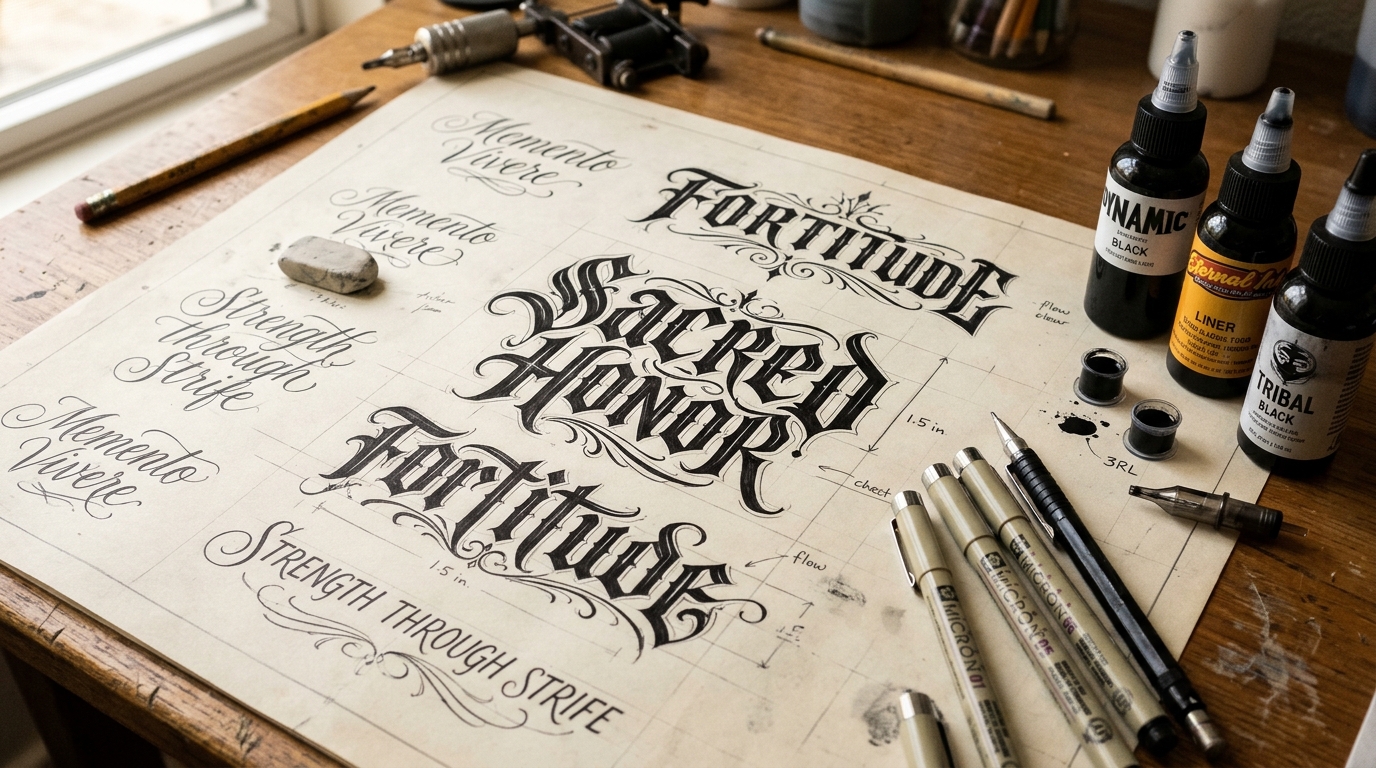
The 6 Core Typographic Classes of Tattoo Art
Tattoo lettering has evolved distinct visual dialects rooted in prison culture, medieval calligraphy, and monumental masonry:
1. Chicano Custom Script
Pioneered in East Los Angeles and California state facilities. Features dramatic weight transitions, soaring looping ascenders, and feathered drop shadows. Designed to sweep across chests and stomachs.
2. Old English / Blackletter
Originating from 12th-century Gutenberg medieval movable type. The heavy vertical fractured strokes and high carbon black saturation create the most permanent, readable typography known in body art.
3. Roman Chiseled / Lapidary
Inspired by Trajan's Column in Rome. Clean geometric capital proportions with subtle chisel serifs. Imparts timeless gravitas for dates, coordinates, and family memorials.
4. Vintage Typewriter Monospace
Replicates mechanical ink hammer strikes on textured paper. Subtle ink bleeds and imperfect serifs provide an organic, literary aesthetic for literary quotes.
The Physics of Tattoo Blowout & Micro-Lettering Collapse
Why do experienced tattoo artists refuse to tattoo micro-script quotes under half an inch tall? The answer lies in cell biology:
- Macrophage Phagocytosis: Dermal immune cells engulf tattoo pigment particles to contain them. Over decades, these cells die and release ink to neighboring cells, causing linework to expand outward by roughly 0.05 to 0.1 mm every year.
- Negative Space Collapse: In letters with small enclosed counters (like the loop in a lowercase e or a), expanding ink borders gradually meet. If the letter is under 0.75 inches tall, the loop disappears completely into a solid black smudge by Year 7.
- The Sizing Rule: Always scale lettering at least 25% larger than your initial instinct. Sizing up guarantees your quote remains legible when you are 60 years old.