TattooChartINDEX
5-Axis Placement Analysis

Tattoo Placement & Body Chart

Where you put your tattoo determines how much it hurts, how fast it fades, how easily you can hide it for work, and how gracefully it ages over 30 years. Compare anatomical zones below.

Top First Tattoo Spot
Outer Bicep (2.0/10)
Highest Stretch Risk
Lower Abdomen / Hips
Fastest Fading Zones
Fingers & Palms
Concealable Canvases
Tier 1: 100% Hidden
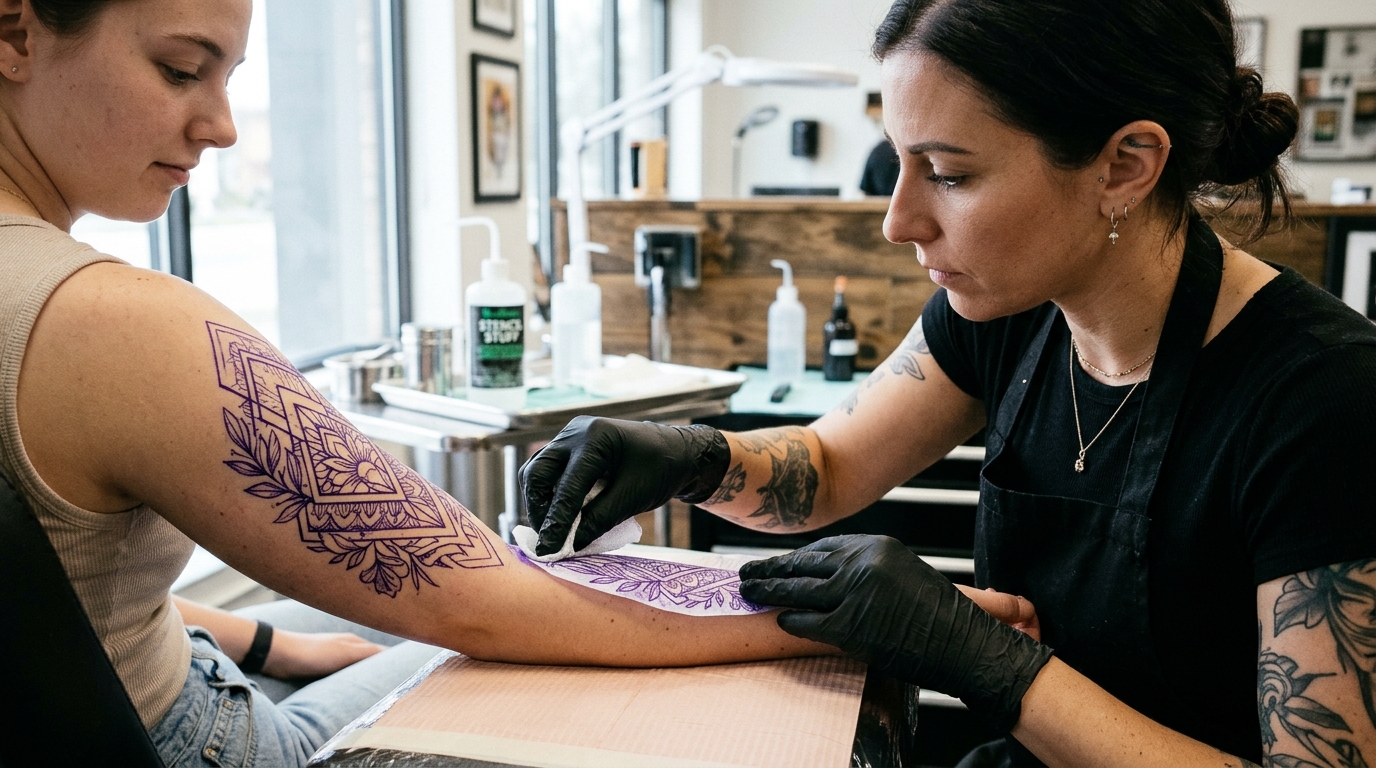
Tattoo artist in black gloves applying purple carbon stencil design onto client arm in studio
Stencil Application
Anatomical Alignment & Joint Flexion

Testing body movement and muscular curvature before permanent needlework.

Personalized Algorithmic Match

Find Your Ideal Body Placement: 60-Second Recommendation

Answer 4 quick lifestyle questions to discover which anatomical zones best match your career, pain endurance, and long-term aging goals.

Recommended Placements For Your Profile:
Top Matches Calculated
⚠️
Cautionary Zones for Your Profile:

Part 02 / Anatomical Model

Interactive Body Placement Chart

Select anatomical zones to view pain index, visibility classification, and aging dynamics.

Filter Placements:
Select an anatomical location to inspect full metrics:
Tier 1: Fully CoverableArms

Outer Bicep & Deltoid

2.0/ 10 Pain

The ultimate canvas for first tattoos. Virtually zero friction, minimal pain, and effortlessly covered by standard t-shirts.

Aging & Friction Risk
Low Friction (Lasts Decades)
Stretch & Distortion Risk
Stable Canvas
Canvas Capacity
Large (8–14 in)
Healing Difficulty
Easy
Best Suited Tattoo Styles
American TraditionalNeo-TraditionalBlack & Grey PortraitsJapanese Irezumi

Master Placement Directory

5-Axis Anatomical Placement Matrix

Filter and sort 20+ body zones across clinical pain, workplace concealability, friction aging, and skin stretch risk.

Anatomical Zone & ContextPain Level (1–10)Workplace VisibilityAging & FrictionSkin Stretch RiskSuitability
Outer Bicep & Deltoid
The gold standard first tattoo placement. Thick muscular padding, minimal nerve density, easily hidden under short sleeves.
2.0 / 10100% CoverableLowLowTop Pick for Beginners
Outer Forearm
Flat, stable canvas with resilient skin. Great visibility for personal appreciation and easy to cover with long sleeves.
2.5 / 10Seasonally VisibleLowLowTop Pick for Beginners
Inner Forearm
Smooth, pale skin delivers high contrast. Pain increases near the wrist crease where tendons and nerves surface.
4.0 / 10Seasonally VisibleLowLowBeginner Friendly
Inner Bicep
Extremely thin, soft skin with high sensory nerve concentration. High stinging sensation and intense friction against the torso.
7.0 / 10100% CoverableModerateModerateExperienced
Elbow & Ditch
Elbow tip vibrates against bone; inner ditch has delicate paper-thin skin that creases constantly during healing.
9.0 / 10Seasonally VisibleHighHighCollectors Only
Upper Back & Shoulder Blades
Expansive, flat surface ideal for medium to large murals. Pain spikes when needles pass directly over the scapular ridge.
5.5 / 10100% CoverableLowLowBeginner Friendly
Spine (Vertebrae)
Central nervous system vibration resonates through entire skeleton. Stunning vertical symmetry but physically grueling.
9.0 / 10100% CoverableLowLowExperienced
Chest & Sternum
Sternum bone has no fat cushion; intense acoustic resonance in chest cavity. Centerpiece for chest rockers and eagles.
9.5 / 10100% CoverableLowModerateCollectors Only
Ribcage & Flank
Agonizing vibration over intercostal nerves and rib bones. High emotional reward; stunning curving placement.
9.5 / 10100% CoverableModerateModerateExperienced
Stomach & Abdomen
Soft, pliable tissue requires steady artist stretching. Highly vulnerable to distortion from significant weight fluctuation.
7.5 / 10100% CoverableModerateHighWeight Sensitive
Outer Thigh
Massive surface area with thick quadricep muscle cushion. One of the easiest places on the body to sit for 4+ hours.
3.5 / 10100% CoverableLowLowTop Pick for Beginners
Calf (Outer & Rear)
Good muscle padding on gastrocnemius. Sensation sharpens towards the Achilles tendon and back of the knee.
4.5 / 10Seasonally VisibleLowLowBeginner Friendly
Shins & Kneecap
Zero muscle over tibia bone. Needles chatter violently against bone periosteum, causing involuntary foot twitches.
8.5 / 10Seasonally VisibleModerateModerateExperienced
Ankles & Top of Foot
Thin skin over tarsal bones and extensor tendons. Shoes and sock friction cause premature fading and scab tear-out.
8.5 / 10Seasonally VisibleHighLowHigh Maintenance
Hands & Knuckles
Historical "job stopper". Constant sun exposure, hand washing, and cell turnover cause rapid blurring and fallout.
8.5 / 10Permanent VisibilityHighLowCollectors Only
Neck & Throat
Dense nerve clusters, jugular proximity, and involuntary swallowing reflexes. Impossible to conceal without turtlenecks.
8.5 / 10Permanent VisibilityLowModerateCollectors Only

Studio Science & Body Dynamics

Anatomical Contouring: How Artists Align Stencils to Muscle Flow

A tattoo does not exist on flat paper—it lives on a living, flexing, breathing sculpture. Understanding muscle contouring and joint flexion ensures your artwork looks stunning in motion, not just in a static photo.

🔄Rotational Flexion

The Forearm Pronation Twist

When you rotate your wrist from palm-down to palm-up, forearm skin twists across the ulna and radius bones by up to 45 degrees.

Artist Placement Rule:

Always stand completely upright with arms resting naturally at your sides when the stencil is applied. Never hold your arm out flat or twist your wrist during stencil placement, or the tattoo will warp crooked whenever your arm hangs naturally.

💡Check your design in a full-length mirror while walking, not just looking down at your wrist.
🧭Traditional Compass

The Inward-Facing Direction Rule

Animals, portraits, daggers, and figures should face forward with your gaze or inward toward the midline of your body.

Artist Placement Rule:

An eagle, tiger, or portrait facing backward towards your spine feels visually disjointed and opposes your forward momentum. In classic tattooing tradition, art faces forward to "look ahead into the world."

💡Exceptions exist for symmetrical mirror pairs (e.g., dual chest panthers facing each other).
💪Muscular Contour

The Deltoid & Bicep Teardrop

The shoulder and bicep form a dynamic teardrop curve rather than a flat cylinder.

Artist Placement Rule:

Circular or square flash placed dead-center on the deltoid will distort when the arm moves. Professional artists taper the top of the design to match the deltoid insertion and flare the base around the tricep divide.

💡Tapered designs make your arms look broader and more muscular.
🫁Respiratory Dynamics

The Ribcage S-Curve & Breath Factor

The ribcage expands and contracts up to 2 inches with every breath cycle, creating continuous dynamic skin tension.

Artist Placement Rule:

Tattoo stencils on the ribs must be applied while standing at normal resting breath. Align lettering and organic florals along the natural S-curve of the rib arch rather than a rigid horizontal line, which breaks when bending sideways.

💡Practice steady belly breathing during the session to keep needle vibration uniform.
👀Wrist Orientation

The "For Me vs. For Others" Dilemma

Should small wrist quotes and symbols be tattooed right-side up for you to read, or right-side up for the world?

Artist Placement Rule:

In fine art and classical tattooing, the body is treated as a canvas. When your arms hang at your sides, text oriented "for you" is upside down to everyone else. While personal preference rules small sentimental scripts, large artwork is universally positioned right-side up to an external observer.

💡If it is a personal grounding affirmation, having it face you is acceptable—just be aware that casual observers will see it upside down.

Part 04 / Career & Social

Workplace Tattoo Concealability: The 3 Visibility Tiers

While tattoo acceptance has expanded worldwide, certain career fields (law, finance, healthcare, defense, corporate hospitality) still maintain formal dress codes regarding visible body art. Plan your placement strategically using the 3 Visibility Tiers:

Tier 1: 100% Coverable

Chest, Ribs, Thighs, Back, Upper Arm

These locations remain completely hidden under standard short-sleeved shirts, polo tops, or blouses. You maintain total personal autonomy over when and where you share your tattoos.

Tier 2: Seasonally Visible

Forearms, Calves, Ankles, Collarbone

Visible during casual summer attire (t-shirts, shorts, dresses), but easily concealed beneath long sleeves or slacks during formal meetings or client presentations.

Tier 3: Permanent Visibility

Hands, Fingers, Throat, Neck, Behind Ears, Face

Historically termed "job stoppers." These areas cannot be hidden without heavy theatrical makeup or high turtle-necks. Most professional artists require clients to be 21+ and already heavily tattooed on covered body zones before accepting a hand or neck booking.

2026 Industry Dress Code Breakdown

Real-world tattoo policies across corporate, medical, and service sectors:

Corporate Law & FinanceStrict

Must remain 100% hidden in client meetings. Visible tattoos on forearms or hands are still viewed as non-traditional in courtroom litigation and investment banking.

Healthcare & NursingModerate

Most modern hospitals allow visible forearm and arm tattoos under scrubs provided artwork contains no offensive or graphic themes. Hands/neck vary by hospital.

Tech, Startups & DesignUnrestricted

Tattoos of all tiers (including full sleeves, neck, and hands) are virtually universal in software engineering, digital design, and startup environments.

Aviation & Flight CrewsModerate

Airlines like Virgin Atlantic now permit visible arm tattoos; however, many Asian and Middle Eastern international carriers still strictly ban all visible tattoos.

Military & First RespondersStandardized

U.S. Army, Navy, and Air Force have modernized tattoo policies: sleeves are broadly permitted; neck is limited to one 1-inch tattoo behind the ear; hands limited to one ring.

Luxury Hospitality & Fine DiningVaries

Front-of-house staff at 5-star hotels often require long sleeves or makeup coverage; back-of-house culinary teams have celebrated body art culture for decades.

Part 05 / Skin Elasticity

Body Changes: How Weight Fluctuations & Pregnancy Affect Tattoos

Human skin is an elastic biological organ containing elastin and collagen fibers. When skin expands gradually (such as gaining 15–20 pounds of muscle over several years in the gym), tattoos stretch proportionally without loss of clarity.

High Risk vs. Low Risk Dermal Zones:

  • High Risk Zones: Lower abdomen, flanks, hips, breasts, and inner thighs. During pregnancy or rapid weight gain, dermal fibers can rupture, creating stretch marks that permanently scar and disconnect ink lines.
  • Stable Canvases: Upper back, shoulders, outer forearms, and calves experience minimal dimensional alteration during standard adult weight shifts.
Expert FAQ

Tattoo Placement & Visibility Questions

Essential guidance before finalizing your tattoo stencil placement.

What tattoos are considered "job stoppers"?

In professional tattoo culture, hands, fingers, neck, throat, and face placements are historically termed "job stoppers." Because they cannot be concealed under standard business casual attire (collared shirts and slacks), many conservative industries, corporate offices, and customer-facing roles maintain strict policies against them. Reputable artists often refuse to tattoo these areas unless a client is already heavily covered.

Will getting tattooed on my stomach or ribs stretch if I gain weight or become pregnant?

Yes. The lower abdomen, stomach, and hips undergo the greatest dermal stretching during pregnancy or rapid weight fluctuations (>30 lbs). While tattoos expand smoothly during gradual muscle growth, sudden skin tears (stretch marks) that penetrate the dermis will fracture ink lines permanently. Upper back, outer arms, and calves are far more resilient to weight changes.

Why do finger and palm tattoos fade so quickly?

The skin on your hands, palms, and fingers experiences extreme cellular turnover, constant friction, and frequent hand washing. Furthermore, the epidermis on the palm is much thicker and lacks standard hair follicles, making it difficult for ink to settle consistently without causing either rapid fallout or blurry subcutaneous blowouts.

How do I choose the right placement for my first tattoo?

The ideal first placement balances three elements: low pain, high resilience to friction, and flexible concealability. The outer forearm, outer bicep, and outer thigh are the top recommendations. You can view and appreciate the art yourself, pain is minimal (2 to 3.5/10), and you can conceal it whenever necessary.

Does muscle growth from bodybuilding distort arm tattoos?

Gradual, natural muscle gain (even 10–20 lbs of lean mass) expands tattoos evenly without noticeable distortion. However, rapid growth combined with stretch marks on the bicep/pectoral crease can tear through the ink layer. Symmetrical geometric tattoos are more susceptible to visual distortion than organic florals or traditional flash.

Connected Reference Suite
View all 8 interactive tools