TattooChartINDEX
Optical Melanin Physics

Tattoo Color & Skin Tone Visualizer

Tattoo ink does not sit on top of skin—it settles deep in the dermis beneath your natural melanin filter. Preview how tattoo colors, jewel tones, and blackwork interact with Fitzpatrick skin types I through VI.

Optical Mechanism
Epidermal Stained Glass
Universal Longevity
Saturated Jewel Tones
Highest Lightfastness
Carbon Black (8/8)
Best Practice Test
60-Day Swatch Patch
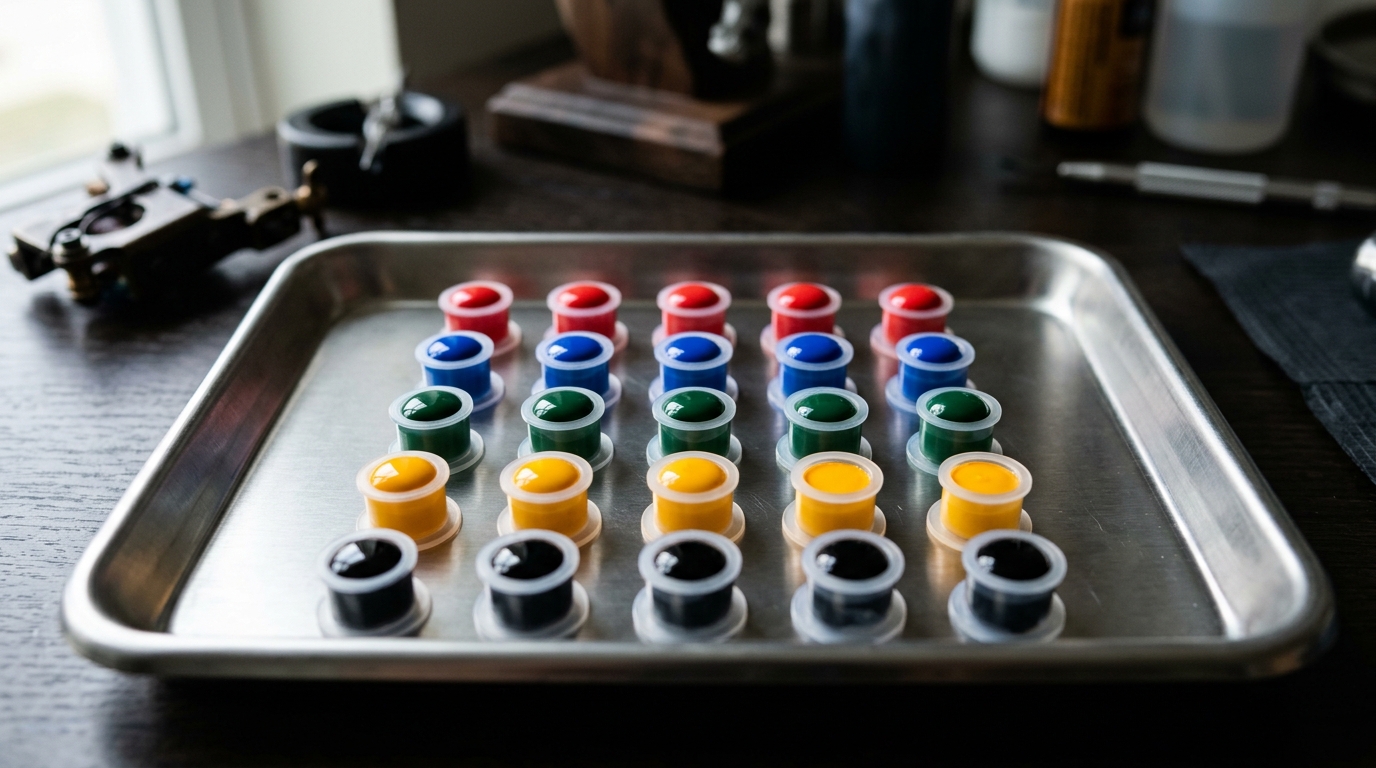
Vibrant rows of colorful tattoo ink pigment caps in red, blue, green, and yellow arranged on sterile medical tray
Pigment Spectrum
Raw Pigments vs. Melanin Filter

Unfiltered ink hues before settling beneath regenerated epidermal melanin.

Non-Medical Educational Advisory

The information, pain ratings, and aftercare timelines provided on TattooChart are for educational reference and client preparation only. They do not constitute formal medical or dermatological advice. Individual biology, immune response, and nerve anatomy vary widely. Always follow the specific aftercare protocols issued by your licensed tattoo artist, and seek immediate professional medical attention if you exhibit signs of infection (e.g., spreading heat, red streaks radiating from the tattoo, yellow pus, or fever).

Type II: Fair / Light Peach
Settled Dermal SimulationEpidermal Optical Filter
Bold Jet Black
Estimated Contrast RatingHigh Contrast (Lifelong Clarity)

Bold black ink delivers permanent maximum contrast. Carbon pigment molecules resist cellular fading across all decades.

The Optical Physics of Settled Ink:Tattoo machines deposit pigment into the dermis (the middle skin layer). During the 30-day healing cycle, your epidermis (the outer layer where melanin pigment is generated) regenerates completely over the ink. Because the epidermis acts like a tinted pane of glass, ink pigments will always be optically filtered by your natural melanin.

Dermatological Optics & Anatomy

The Biological "Stained Glass" Principle: How Skin Filters Ink

Tattoo ink does not sit on top of your skin. It is permanently locked inside dermal macrophages beneath a regenerating layer of melanin. Toggle the melanin slider below to observe how the light spectrum interacts with settled pigment.

Layer 1: Epidermis (0.05 – 0.1 mm)Melanin Filter

Regenerates every 28 days. Melanocytes produce eumelanin (brown/black) and pheomelanin (red/yellow). All ambient light must pass through this layer twice: once going in, and once reflecting back out.

Active Melanin Concentration: Type III: Olive / Light Bronze
↓ Ambient Light In|↑ Reflected Color Out
Layer 2: Dermis (1.5 – 2.0 mm)Permanent Ink Suspension

Tattoo needles deposit insoluble ink particles into dermal macrophage immune cells. Because the dermis does not shed, ink remains trapped here for life within dense collagen fibers.

Macrophage Suspensions
Type I (Fair)Type III (Olive)Type VI (Deep)
Type III: Olive / Light BronzeFilter Factor: 38%

Moderate melanin acts like a light honey-tinted glass. High contrast jewel tones (ruby red, cobalt blue, forest green) shine with vibrant saturation, while faint pastels take on warmer, earthy undertones.


Chromatics & Chemistry

Curated Ink Harmony Profiles: 4 Master Palettes

Not all tattoo inks perform equally over time. Compare the four distinct ink suites used by professional artists to ensure contrast, longevity, and melanin compatibility.

Saturated Jewel Tone Suite

Universal High-Impact

Dense pigment loads with deep molecular saturation. Cut through melanin filters effortlessly and age with striking vibrancy.

Ruby Crimson
Primary Floral / Focal
Sapphire Cobalt
Cold Shadows & Waves
Emerald Forest
Foliage & Scales
Royal Amethyst
Accents & Transitions
Ideal for Fitzpatrick Types I through VI

Warm Earth & Ochre Suite

Warm Undertone Harmony

Blends organically with natural pheomelanin undertones. Creates a warm, antique, traditional illustrative atmosphere.

Burnt Terracotta
Warm Daggers / Florals
Golden Ochre
Scrolls & Highlights
Raw Umber
Wood & Leather Shading
Sepia Sienna
Traditional Shading
Exceptional on Fitzpatrick Types III, IV, and V

High-Contrast Blackwork & Skin Breaks

Heirloom Longevity

Carbon black particles have the largest molecular footprint and highest opacity. Negative space skin breaks provide the contrast engine.

Triple Carbon Black
Outlines & Solid Pack
Dark Charcoal Wash
Depth & Dimension
Medium Slate Wash
Smooth Feathering
Negative Skin Break
Natural Skin Contrast
10/10 Contrast on All Skin Phototypes

High-Maintenance & Volatile Inks

Requires Diligent SPF 50+

Low-opacity pigments with small molecular bonds. Vulnerable to UV breakdown and melanin discoloration over 3 to 5 years.

Titanium White
Specular Highlights Only
Pastel Lavender
Watercolor Shading
Baby Sky Blue
Delicate Fills
Lemon Yellow
Fades to Amber Under Melanin
Best on Types I–II; Prone to Discoloration on V–VI

Chemical Stability & Lifespan

Pigment Chemistry & Molecular Lightfastness Guide

How long will different tattoo colors stay vibrant? Tattoo pigments range from indestructible carbon black to photochemically volatile pastels. Compare scientific ratings on the 8-point Blue Wool Scale.

8 / 8 (Maximum / Immortal)30+ Years

Carbon Black (CI 77266)

Elemental carbon nanoparticles with maximum light absorption across the entire optical spectrum.

Artist Verdict: Highest lightfastness known in dermatology. Outlines remain bold and lightfast for life.
7 – 8 / 8 (Exceptional)20 – 30 Years

Phthalocyanine Blue & Green

Synthetic copper complexes engineered for extreme industrial chemical and solar UV resistance.

Artist Verdict: Deep sapphire blues and forest greens maintain rich saturation with minimal fading.
6 – 7 / 8 (Very High)15 – 25 Years

Quinacridone & Naphthol Crimson

Polycyclic organic compounds with tightly bound benzene rings that resist solar photon degradation.

Artist Verdict: Delivers brilliant scarlet and ruby red tones with great endurance when shielded with SPF 50.
3 – 4 / 8 (Moderate / Sensitive)5 – 10 Years

Azo Yellows & Oranges

Azo nitrogen linkages that gradually break down when subjected to ultraviolet radiation.

Artist Verdict: Fades fastest of all chromatic pigments and turns honey-brown under high melanin levels.
2 – 3 / 8 (Volatile Highlight)2 – 5 Years

Titanium Dioxide White (CI 77891)

Inorganic mineral pigment. Highly reflective when fresh, but gradually absorbs sebum oils and melanin.

Artist Verdict: Never use for large solid fields. Best reserved for tiny specular reflection dots in eyeballs or dagger tips.
🎨

The 60-Day Color Swatch Protocol

If you have olive, bronze, or deep brown skin and are unsure how colored ink will look beneath your unique melanin filter, professional artists recommend a Color Swatch Test:

Step 1: The 5-Dot Swatch

During a consultation, the artist places 4 to 5 small dots or 5mm dashes of different pigments (ruby red, sapphire blue, emerald, amber, violet) in an inconspicuous zone like your hip or inner bicep.

Step 2: 60-Day Dermal Settlement

Allow the skin to undergo a complete 28-day epidermal shedding cycle and an additional 30 days of deep dermal collagen remodeling.

Step 3: Natural Light Inspection

Inspect the settled dots under natural outdoor sunlight (not artificial studio lamps). You and your artist will see exactly which hues pop with dazzling clarity against your skin.


Part 01 / Dermal Optics

The "Tinted Glass" Principle of Tattoo Melanin

To understand why tattoo ink behaves differently on diverse skin tones, we must look at human skin anatomy:

  • The Epidermis (Top Layer): This is the outermost protective skin barrier. Melanocyte cells in the basal layer produce melanin, the pigment responsible for skin color and tanning.
  • The Dermis (Middle Layer): This is where tattoo needles deposit insoluble ink particles inside macrophage cells.
  • The Optical Result: Once healed, the epidermis covers the tattoo like a sheet of colored glass. You are always viewing dermal ink through an epidermal melanin filter.

If you place bright yellow ink beneath amber glass, the yellow appears golden-brown. If you place bold black ink under that same glass, the black remains sharp and crisp. Understanding this optical law empowers you to choose color schemes that age gracefully for life.

Part 02 / The Fitzpatrick Scale

Fitzpatrick Scale Color Optimization Matrix

Dermatologists classify human skin into 6 distinct phototypes. Here is how tattoo artists calibrate palettes for each:

Types I & II (Fair / Ivory)

Low Melanin

High optical transparency. High contrast for pastels, light greys, and watercolor washes. Prone to immediate skin trauma and UV photodegradation, requiring diligent daily SPF 50+.

Types III & IV (Olive / Light Bronze)

Moderate Melanin

Warm undertones amplify rich primaries (crimson red, cobalt blue, forest green, amber). Soft pastels and pale lavenders can lose definition if not bordered with dark linework.

Types V & VI (Deep Bronze / Dark Brown)

High Melanin

Magnificent canvas for heavy blackwork, bold linework, and saturated jewel tones (deep ruby, emerald, sapphire). High saturation and negative space ensure art remains readable from across a room.

The "Color Swatch" Test

Best Practice

Unsure how a specific pigment will settle? Ask your artist for a quick 5-dot color swatch test. After 60 days of dermal healing, you can inspect settled tones under natural lighting.

Expert FAQ

Tattoo Color & Melanin Questions

Direct answers to color vibrancy and skin tone matching.

Can you get color tattoos on dark or brown skin?

Absolutely yes! Color tattoos look magnificent on melanin-rich skin when designed strategically. Rich jewel tones (ruby red, deep emerald, sapphire blue, royal violet) and warm ambers deliver stunning saturation. The key is working with an experienced artist who understands contrast, saturation density, and bold black linework framing.

Why does tattoo ink look different once it is fully healed?

Immediately after tattooing, ink sits in both the dermis and the freshly punctured epidermis. Over the next 30 days, your outer epidermis sheds and regenerates a fresh layer of skin loaded with your natural melanin. Because you view the settled ink through this melanin layer, healed colors look slightly softer and warmer than when fresh.

Does white tattoo ink stay pure white forever?

No tattoo ink remains pure titanium white permanently. Because the skin above the ink contains natural melanin and is exposed to sunlight, white ink gradually takes on a faint ivory, cream, or golden hue. White is best used for high-impact specular highlights rather than large solid fills.

What is a color test tattoo or "color swatch"?

A color test involves having an artist tattoo small discreet dots or dashes of different ink hues (red, blue, green, purple, yellow) in an inconspicuous area. After 6 to 8 weeks of full dermal healing, you and your artist can inspect exactly how each settled pigment interacts with your unique melanin tone.

Which tattoo ink colors last the longest without fading?

Carbon-based black ink has the highest lightfastness and largest particle size, lasting 30+ years with minimal fading. Among colors, dark blue, forest green, and rich crimson red have strong molecular stability against solar ultraviolet breakdown. Light yellows and baby pastels fade most rapidly.

How do undertones (cool, warm, neutral) affect tattoo colors?

Cool undertones (pink/blue) enhance cool ink hues like teals, purples, and blues. Warm undertones (golden/peach) naturally harmonize with reds, oranges, and warm earth tones. Neutral undertones support the widest dynamic range of pigment palettes.

Connected Reference Suite
View all 8 interactive tools